Frequently Asked Questions
Questions about Army ROTC? Schedule a one-on-one advising appointment to discuss scholarships, degree plans, transfer pathways, or commissioning opportunities before registration deadlines.
The following questions address many of the topics prospective students, transfer students, veterans, parents, and current UMHB students ask when considering Army ROTC.
Getting Started
Army ROTC (Reserve Officers' Training Corps) is a college leadership program that develops students into leaders of character while they complete their college degree. Upon graduation and successful completion of program requirements, cadets commission as Second Lieutenants in the United States Army.
Army ROTC combines academic instruction, practical leadership experience, physical fitness, and mentorship to prepare students for leadership careers in both military and civilian professions.
No.
Students may enroll in the Basic Course (the first two years of Army ROTC) with no military obligation, provided they have not accepted an Army scholarship or signed a contracting agreement.
Many students enroll simply to develop leadership skills before deciding whether military service is right for them.
Yes.
The Basic Course is designed specifically for students interested in learning about Army leadership without making an immediate military commitment.
No.
Army ROTC is a college officer commissioning program. Graduates commission as Army officers after earning their degree.
Enlisting enters the Army as a Soldier immediately after signing an enlistment contract.
No.
Most cadets begin Army ROTC with no prior military experience.
The program is designed to teach students everything they need to know while developing confidence and leadership skills.
High school students interested in earning a four-year Army ROTC scholarship should begin the application process during their junior year of high school and submit their application as early as possible during their senior year.
The National Army ROTC Scholarship Program conducts multiple selection boards throughout the academic year. Applying early allows applicants to be considered by multiple boards and maximizes scholarship opportunities.
Students who are not selected for a National Scholarship may still be eligible for campus-based scholarships after enrolling in Army ROTC at UMHB.
Prospective students are encouraged to contact the UMHB Army ROTC Department before their senior year to discuss scholarship opportunities, degree planning, and enrollment requirements.
Enrollment & Student Pathways
Not necessarily.
Many transfer students and upper-class students successfully join Army ROTC each year.
Depending upon your academic timeline and military experience, you may qualify through:
• The traditional four-year sequence
• Cadet Initial Entry Training (Basic Camp)
• Prior military service credit
• Constructive credit pathways
Schedule an advising appointment as early as possible to discuss your options.
Yes.
Transfer students often have excellent opportunities to participate in Army ROTC. Students with two academic years remaining before graduation may still be eligible to commission through Army ROTC.
The earlier you contact the department, the more options may be available.
Absolutely.
Veterans frequently qualify for accelerated entry into the Advanced Course through prior military service and may already satisfy portions of the Basic Course requirements.
Yes.
Many Soldiers participate through the Simultaneous Membership Program (SMP), allowing them to serve in their military unit while completing Army ROTC and earning a commission.
The Simultaneous Membership Program allows eligible National Guard and Army Reserve Soldiers to participate in Army ROTC while continuing to serve in their military unit.
SMP cadets gain additional leadership experience while receiving both Army ROTC and Guard or Reserve benefits.
Yes.
Graduate students may participate if they have sufficient academic time remaining to complete Army ROTC requirements before graduation.
Yes.
Army ROTC works well with many nursing degree plans and provides opportunities to compete for Army Nurse Corps commissions and nursing-specific scholarships.
As early as possible.
Students should not wait until course registration, orientation, or the first week of classes to ask about Army ROTC.
Meeting with Army ROTC several months before the semester begins provides the greatest flexibility and allows time to:
• Develop an academic degree plan that supports commissioning
• Enroll in the appropriate Military Science courses
• Discuss scholarship opportunities and financial benefits
• Explore transfer student, veteran, or Basic Camp pathways
• Complete required administrative paperwork
• Attend Zero Week and new student orientation activities
• Meet cadre and fellow cadets before classes begin
Students who begin planning early typically have more opportunities available and experience a smoother transition into the program.
Academic Experience
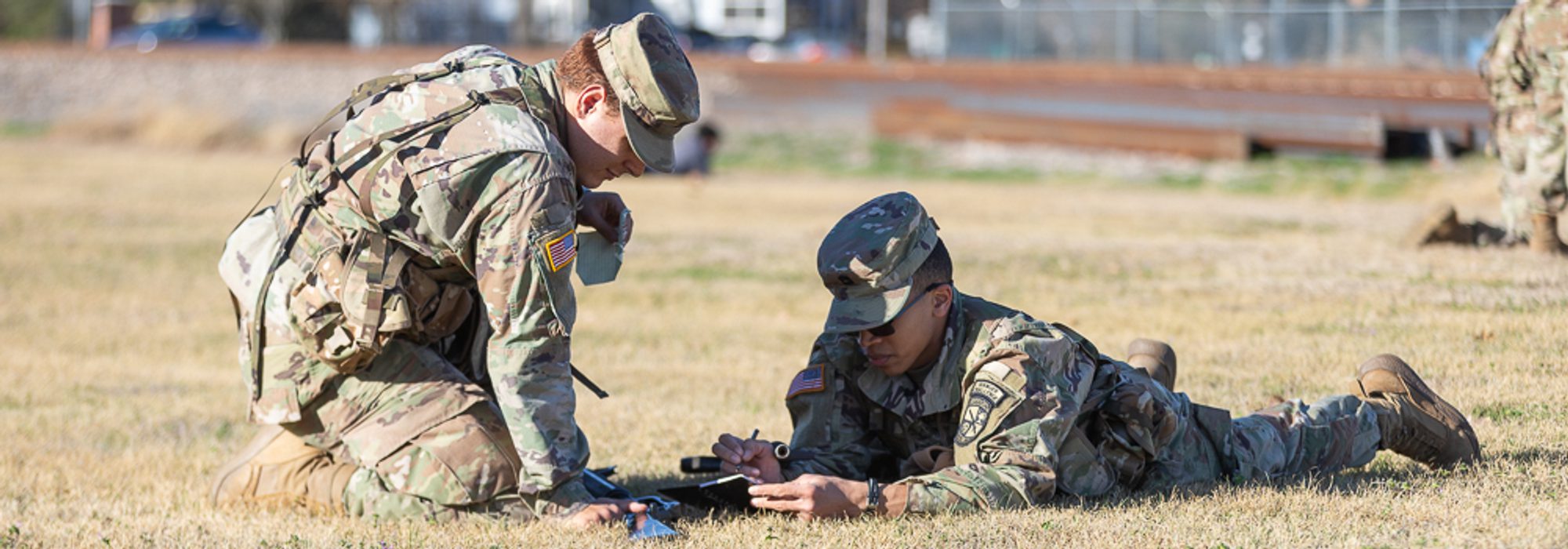
Army ROTC combines classroom instruction with practical leadership laboratories, physical training, field exercises, and team-building activities.
Students develop leadership, communication, problem-solving, and decision-making skills through hands-on experiences.
Cadets study topics including:
• Leadership
• Ethics
• Communication
• Critical thinking
• Army values
• Teamwork
• Mission planning
• Decision making
• Physical fitness
• Organizational leadership
• Problem solving under stress
Many of these skills directly translate into civilian careers.
Most cadets participate in:
• One Military Science class each semester
• Weekly Leadership Laboratory
• Physical Training (3x a week for about an hour)
• One Field Training Exercise each semester
• Occasional service projects or recruiting events
The program is designed to complement a full academic schedule.
Absolutely.
Army ROTC cadets routinely participate in athletics, student organizations, employment, internships, academic clubs, and campus leadership positions.
ROTC is intended to enhance—not replace—the traditional college experience.
Army ROTC includes organized physical fitness training designed to improve strength, endurance, and resilience.
Students are encouraged to arrive ready to participate in college-level physical activity, but prior athletic experience is not required.
Yes—but only during Army ROTC classes, leadership laboratories, physical training, field exercises, and other official Army ROTC events.
Cadets are issued Army uniforms and required military equipment at no cost for participation in official training activities. Outside of Army ROTC events, cadets attend classes, participate in campus activities, and go about their daily routines wearing normal civilian clothing just like any other UMHB student.
Army ROTC is designed to complement your college experience, allowing you to fully participate in campus life while developing leadership skills through the program.
Scholarships & Financial Benefits
Yes.
Army ROTC offers both National and Campus-Based Scholarships for qualified students based on academic achievement, leadership potential, physical fitness, and Army requirements.
High school students, current college students, transfer students, and currently enrolled cadets may all have scholarship opportunities available depending on their academic status and eligibility.
To learn more about National Army ROTC Scholarships, visit: https://armyrotc.army.mil/scholarships/
Students are encouraged to contact the UMHB Army ROTC Department early to discuss scholarship opportunities and eligibility.
Scholarships may provide:
• Full tuition and mandatory fees or
• A room and board option
Scholarship recipients also receive:
• Annual book allowance
• Monthly tax-free stipend
• Uniforms and required equipment
Yes.
Contracted cadets who are not on scholarship still receive a monthly stipend while participating in Army ROTC.
Additional pay opportunities may exist for qualifying Army training.
Yes.
Many cadets receive campus-based scholarships after enrolling and demonstrating academic success, leadership potential, and commitment to the program.
No.
Many cadets participate without scholarships during their first year and later compete for scholarship opportunities.
Commissioning & Military Service
Students who successfully complete Army ROTC requirements and graduate commission as Second Lieutenants in one of three Army components:
• Active Army
• Army National Guard
• United States Army Reserve
Army officers serve in more than twenty career branches, including:
• Aviation
• Cyber
• Military Intelligence
• Engineering
• Medical Service
• Signal
• Logistics
• Finance
• Human Resources
• Infantry
• Armor
• Military Police
• Field Artillery
• Air Defense Artillery
• Transportation
• Quartermaster
• Ordnance
• Civil Affairs
• And many others.
Students enrolled in the Basic Course have no military service obligation.
Contracted cadets are generally placed into a non-deployable educational status while completing their degree requirements. National Guard and Army Reserve Soldiers should discuss individual circumstances with ROTC cadre.
Military service obligations vary depending upon scholarship status, commissioning component, and current Army policy.
Army ROTC cadre can explain current service obligations during individual advising appointments.
In some cases, educational delay programs allow selected cadets to pursue graduate or professional education before entering Active Duty.
These opportunities are competitive and depend upon Army needs
Preparing for Success
Students interested in Army ROTC are encouraged to:
• Focus on academic success
• Maintain physical fitness
• Develop leadership experience through school or community organizations
• Practice time management
• Get involved on campus
• Meet with Army ROTC cadre early to discuss enrollment and scholarship opportunities
As early as possible. Students should not wait until registration or orientation. Early planning allows time for degree planning, scholarship discussions, transfer pathways, paperwork, Zero Week preparation, and enrollment in appropriate courses.
Ready to Learn More?
Whether you're a prospective student, transfer student, veteran, graduate student, current UMHB student, or parent, schedule an advising appointment early to discuss degree planning, scholarship opportunities, transfer pathways, and commissioning options.
Book an Appointment
Contact Information
Department of Military Science
Location: Frazier Hall •
Address: 900 College Street, Box 8014B • Belton, TX 76513
rotc@umhb.edu • (254) 295-4276 or (254) 295-4822